 Virtual Tour




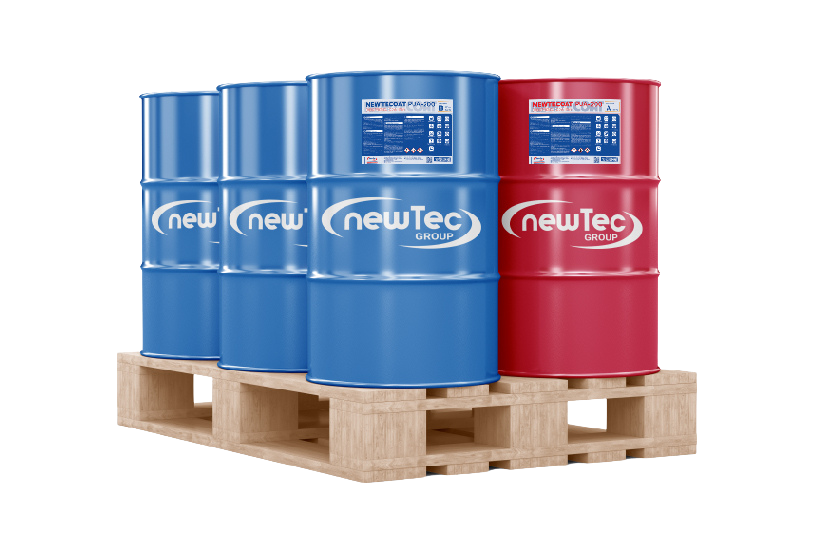

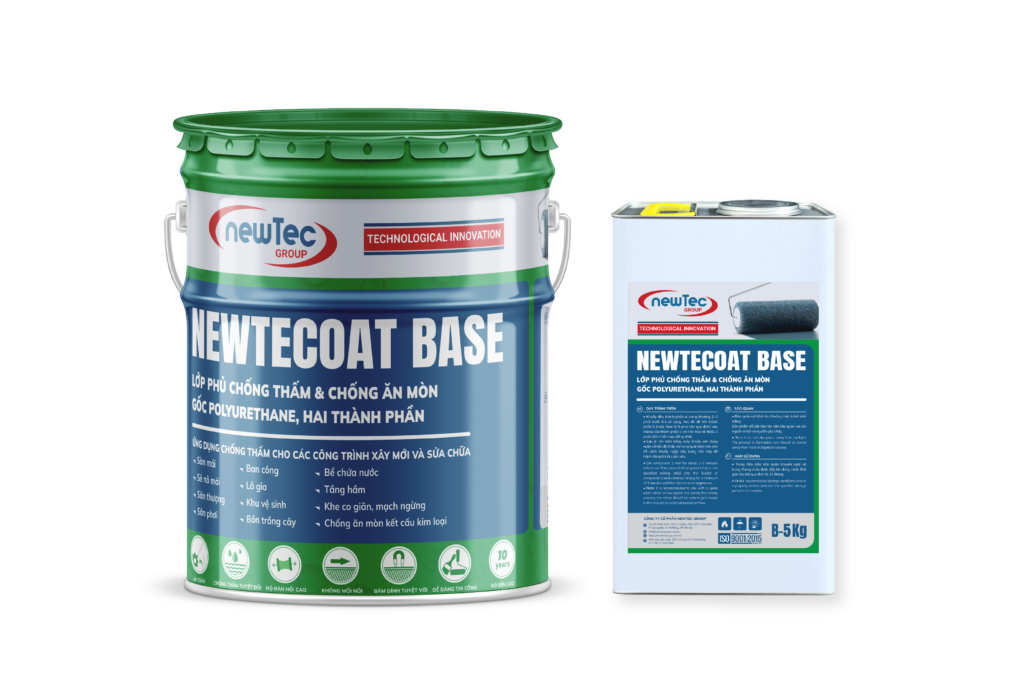

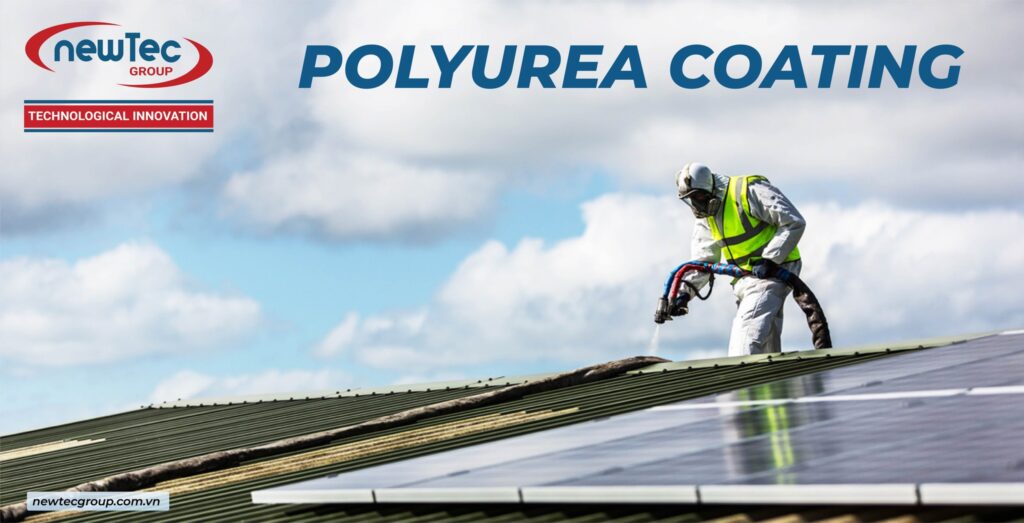
Polyurea is becoming a strategic coating material in infrastructure, heavy industry, and civil engineering projects due to its superior durability, high waterproofing and corrosion resistance , and curing time measured in seconds. However, the clear difference between hot polyurea and cold polyurea is causing many contractors and investors to hesitate.
In this article, Newtec will provide a comprehensive analysis of both product lines from a technical, economic, and performance perspective.
Why is Polyurea considered the “gold standard” in protective coatings?
Polyurea is a seamless coating material formed from the reaction between isocyanate and a mixture of amines, creating an elastic, high-strength, and stable coating in harsh environments. Thanks to its extremely fast curing properties, high tensile strength, high elongation, and chemical resistance, polyurea is widely used in:
- Basement and water tank waterproofing system
- Chemical plants, oil refineries, steel production
- Seaports, coastal areas, concrete-steel structures
- Parking lot decks, bridges, tunnels
- Fabrication of tanks, composite structures
Polyurea has become a strategic material in European, North American, and Asian countries due to its sustainability, rapid construction, and reduced operating and maintenance costs.
According to a report from Fortune Business Insights (2025), the global waterproofing membrane market is valued at approximately US$32.43 billion, with the Asia-Pacific region accounting for over 41.47% of the market share. Growth is primarily driven by the demand for protecting structures from climate change and rapid urbanization.
Distinguishing Polyurea: Hot and Cold Forms
Polyurea currently has two main groups:
- Hot Spray Polyurea – applied using a high-pressure spray machine with heating.
- Cold-Applied Polyurea – easy to apply with a brush, roller, etc.
COMPARISON TABLE OF HOT AND COLD POLYUREA
| CRITERIA | HOT SPRAY POLYUREA | COLD-Applied Polyurea (Cold-Applied Polyurea) |
|---|---|---|
| Reaction mechanism | 100% pure polyurea reaction between isocyanate and polyamine at high temperature. | The reaction is slightly slower than the hot form. |
| Construction method | High-pressure , two-component spray machine , heated to 60-80°C. | Application without heating , easier: brush, roller, squeegee |
| Curing speed | 5-10 seconds → walk again after <1 minute | Over 5 minutes → walk around after 1–2 hours |
| Surface seamlessness | 100% seamless, no joints , no overlapping marks. | Overlapping marks may appear when applying multiple layers. |
| Mechanical properties (tensile strength, elongation, wear resistance) | Very high , suitable for heavy industrial environments. | Good |
| Chemical resistance | Excellent: gasoline, solvents, salts, alkalis, mild acids | Average to good, not suitable for strong chemicals. |
| UV resistance | A UV-protective topcoat is needed. | A UV-protective topcoat is needed. |
| Material lifespan | 20-30 years (standard conditions) | 15 years |
| Construction thickness | 1.5 – 3.0 mm | 1.5 – 3.0 mm |
| Ability to work in humid environments | Stable, minimal impact | More sensitive to humidity |
| Adhesion | Good (It is recommended to use a primer to increase adhesion) | Good, easy to surface treat. |
| Environmental stability | Good resistance to weathering, vibration, and structural deformation. | Subject to moderate volatility |
| Construction safety level | Highly specialized skills required, full PPE needed. | Safer, easier to operate. |
| Material costs | High | Average – Low |
| Equipment costs | Very high (Graco sprayers, PMC, etc.) | Low cost, simple investment. |
| Optimal application range | Chemical plants, oil and gas facilities, heavy-duty truck parking areas, large roofs, industrial floors, offshore structures. | Balcony, toilet, technical room, landscaping, local repairs, minor items |
| Suitable candidates | Professional contractor, industrial projects | Civil engineering projects, general contractors |
Should hot-applied or cold-applied polyurea be chosen for each type of construction project?
Thermoplastic polyurea should be chosen when:
- Chemical plants, oil and gas facilities, acid and alkali storage facilities.
- Power plants, steel mills, wastewater treatment plants.
- Seaports, wharves, coastal areas.
- Parking lot floors, tunnels, and heavy load-bearing structures.
- These projects require maximum protection and long-term durability.
Cold-pressed polyurea should be chosen when:
- Balcony, rooftop, toilet, residential basement.
- A small area with many winding details.
- Repair and patch localized mulch.
- The projects require flexible timelines and a tight budget.
If budget allows and long-term durability is required, hot-melt type is preferred.
If flexibility is needed, cold-melt type is the better option.
Newtec Group – A pioneer in polyurea production in Vietnam
As a leading company in the research of next-generation coating materials, Newtec Group has mastered the technology for producing polyurea in both hot and cold forms, meeting international standards.

Overview
Newtec Group is proud to be the first company in Vietnam to produce polyurea of quality equivalent to imported products.
Mastering the technology ensures the stability of materials in Vietnam’s climate. The quality control system meets international standards.
Supplying materials for numerous key national projects: industrial plants, reservoirs, technical infrastructure, etc., Newtec has become a trusted partner of major players such as VinGroup, Becamex, Long Thanh International Airport, and others.
Competitiveness

With its own research, development, and production capabilities, Newtec Group ensures competitive pricing compared to imported polyurea. In addition, the company also provides both hot-mix and cold-mix polyurea, improved to suit all needs.
With high professional expertise, combined with professional training from domestic and international courses, the engineers and staff at Newtec are confident in diagnosing problems with your project and providing the most optimal solutions.
Conclude
Both hot-applied and cold-applied polyurea play distinct roles in modern coating systems. However, the correct choice depends on specific technical requirements and application conditions.
Newtec Group – a pioneering enterprise in Vietnam in the research and production of polyurea coating materials – has fully mastered the technology, meeting international standards in industrial waterproofing and corrosion resistance. With a modern laboratory system and a team of experienced engineers, Newtec Group is a reliable choice for all high-quality polyurea solutions.
 Virtual Tour


You may also be interested in
MARINE COATING SYSTEM FOR SHIPS OPERATING ACROSS SEA REGIONS
Corrosion Protection – Fouling Control – Comparison of Epoxy, PU, and Modified Polyurea In the
Mar
Newtec Group appoints Deputy General Director, enhancing management capabilities
On the morning of February 2nd, amidst the joyful and enthusiastic atmosphere of welcoming the
Mar
Newtec Group joins hands with the “Tet for the Poor – Winter for Children 2026” program in Nghe An
On January 29th, Mr. Mach Tho Cuong, representing Newtec Group Joint Stock Company, was present
Mar
WATERPROOFING AND CORROSION PROTECTION FOR THE ENERGY INDUSTRY
1. General context: As energy infrastructure faces the challenges of time. For over a century
Jan
HOT OR COLD POLYUREA?
Polyurea is becoming a strategic coating material in infrastructure, heavy industry, and civil engineering projects due to its
Dec
NEWTEC GROUP’S MARK AT VINA COATINGS 2025
At the Vina Coatings 2025 International Exhibition , Newtec Group made a strong impression with a series of groundbreaking
Dec
NEWTEC GROUP PARTICIPATED IN VINA COATINGS FAIR HO CHI MINH CITY 2025
Newtec Group is pleased to announce that it will participate in the International Paint and Coating
Nov
NEWTEC GROUP welcomes leading experts in construction materials at VIETBUILD 2025
Newtec Group is honored to welcome leading experts in the construction materials industry at the company’s
Oct